HW Celebrates City of Chicopee’s Award-Winning Comprehensive Plan

Envision Our Chicopee: 2040 Recognized by American Planning Association Massachusetts Chapter

Horsley Witten Group (HW) applauds the City of Chicopee, whose first-ever comprehensive plan, Envision Our Chicopee: 2040, was recently awarded the 2025 Comprehensive Planning Award by the American Planning Association’s Massachusetts Chapter (APA-MA). The award recognizes the plan’s innovation, quality, and impact in guiding the city’s long-term growth.

HW led the planning effort for Envision Our Chicopee: 2040, working closely with the Chicopee Department of Planning & Development, a volunteer steering committee, and the community. Launched in 2019, the process engaged residents and stakeholders through surveys, digital open houses, and other creative approaches adapted for pandemic conditions at the time.

The APA-MA Comprehensive Planning Award is presented annually to outstanding plans, programs, or projects, including comprehensive and master plans, environmental conservation strategies, housing plans, and economic development initiatives. Chicopee’s plan received the award in recognition of its contribution to the city’s long-term vision.


“This recognition underscores the beginning of a renaissance for the City of Chicopee,” said Jeff Davis, Senior Planner at Horsley Witten Group. “The plan reflects the city’s vision for a more equitable, vibrant, and resilient future, and we’re grateful to APA-MA for honoring the work of everyone who contributed to making it possible.

“We are honored APA-MA has recognized Envision Our Chicopee: 2040,” said Lee Pouliot, Director of Planning & Development.Today, with the adoption of Envision Our Chicopee: 2040, Chicopee now has a vision for its future and a roadmap of priority projects to ensure that vision is realized.  I am proud of the work our Planning Team, led by Horsley Witten Group accomplished under trying circumstances, and honored to have watched the Planning Board adopt and the City Council endorse this plan.  We look forward to working with all stakeholders as implementation efforts continue.” 

Envision Our Chicopee: 2040 provides a framework for sustainable growth, economic opportunity, and quality of life. It outlines key priorities, including a complete zoning code update, mixed-use and infill development, preservation of historic and natural resources, and initiatives to maintain equity and inclusion across the city. The plan was unanimously approved by the Chicopee Planning Board and endorsed by the City Council.


elizabeth perry

administrative coordinator

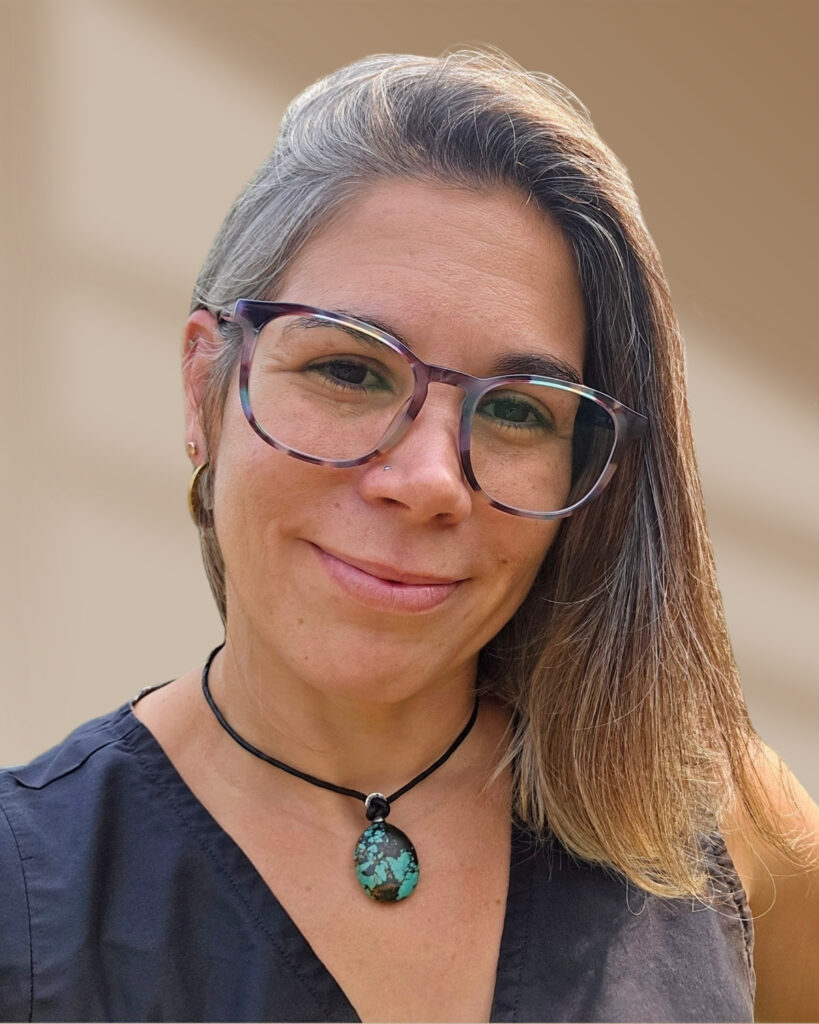
The Horsley Witten Group is excited to announce that Elizabeth Perry (Liz) has joined our Sandwich Operations Team as an Administrative Coordinator. Liz earned a Bachelor of Arts Degree in Mathematics from Southern New Hampshire University. She has years of experience in bid preparation, estimating, finance, plan review, and sales support.

A lifelong learner, Liz is always looking to improve her skills. She appreciates technology and is happiest when helping others to analyze and improve processes. Liz has worked independently for herself, thrived as a cost estimator and administrative assistant in the commercial construction field, and as a stay-at-home parent.


Liz grew up in Swansea and was surrounded by relatives who immigrated from Portugal. Grandparents and parents who made their livelihoods working in textile mills and fishing nearby waters shared important life skills with her like sewing, textile arts, fishing, and map study. In high school she enjoyed field hockey (wishing the school had a girl’s ice hockey team), softball, and the drama club. She appreciates fine art and spending time with her family. She is a hockey fan from a hockey family and when not working she can be found at an ice rink cheering on her three children, of whom two are goalies! Liz also enjoys knitting, embroidery on kid’s t-shirts, and sewing. Welcome to HW Liz, we are so happy that you are here!


casey proto

staff Scientist

The Horsley Witten Group is happy to announce that Casey Proto has joined our Sandwich Restoration team as a Staff Scientist. Casey recently earned a Bachelor of Science degree in Marine Science, Safety, and Environmental Protection from the Massachusetts Maritime Academy (MMA). During his time at MMA, Casey enjoyed being a peer tutor in the chemistry department and being part of a study on eelgrass health and its abundance in Buzzards Bay. Additionally, Casey had the opportunity to mentor underclassmen students during a tropical ecology field course at the Bermuda Institute of Ocean Sciences.

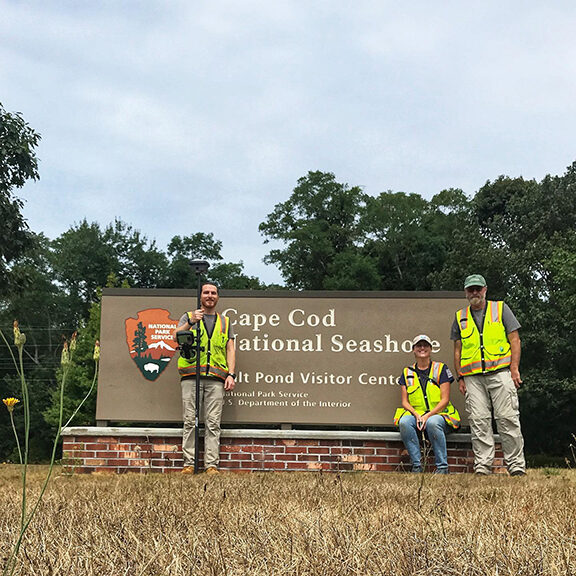
Casey has completed internships with the Woods Hole Oceanographic Institution (WHOI) and the Association to Preserve Cape Cod (APCC). As a Compliance Intern in the Ship Operations Department at WHOI, Casey worked to ensure the Institution’s vessel operations complied with safety and environmental regulations through reviewing and drafting documents and protocols.  At APCC, Casey collected and analyzed water samples from freshwater ponds to identify and quantify cyanobacteria. His current project portfolio includes a watershed assessment, environmental due diligence assignments, GIS work, and field work related to water sampling and topographic surveying.

Growing up in Centerville, Casey enjoyed the various Cape Cod landscapes and the numerous hiking trails, which grew his appreciation for the local environment. When not working he can be found golfing, reading, or hiking with his Golden Retriever Charlie.

Welcome to HW Casey, we are glad you are here!


Tom Noble Training

hw awarded $10 million EPA contract

hw news release

Emergency preparedness, response and recovery programs to protect public drinking water supplies


Horsley Witten Group, a full-service environmental consulting firm providing sustainable and resilient design solutions, has been awarded a five-year contract valued at up to $10 million from the U.S. Environmental Protection Agency (EPA).

Under the terms of the agreement, Horsley Witten Group will develop, implement and support programs to protect the nation’s drinking water and wastewater systems from natural disasters, man-made incidents, and the effects of climate change.

Working with the EPA’s Water Infrastructure and Cyber Resilience Division (WICRD), some highlights of Horsley Witten Group support will include developing emergency response training and workshops, conducting risk assessments, developing cyber risk management solutions and identifying contamination mitigation strategies for community drinking water systems.

The contract represents the EPA’s latest engagement with Horsley Witten Group since the tragic events of September 11, 2001, when the agency initiated federally mandated activity to protect the nation’s drinking water supplies against terrorist attacks.

In 2022, the EPA honored Horsley Witten Group with its Small Business Award, recognizing the organization for its exemplary customer support, technical adaptiveness, and responsiveness during the COVID-19 pandemic.

“We look forward to continuing our longstanding and productive partnership with the U.S. EPA to help safeguard the nation’s drinking water supplies and wastewater treatment facilities. For more than two decades we have worked closely together to create sustainable solutions to ensure that water and wastewater utilities are resilient from a wide range of natural, man-made, and nefarious threats.”
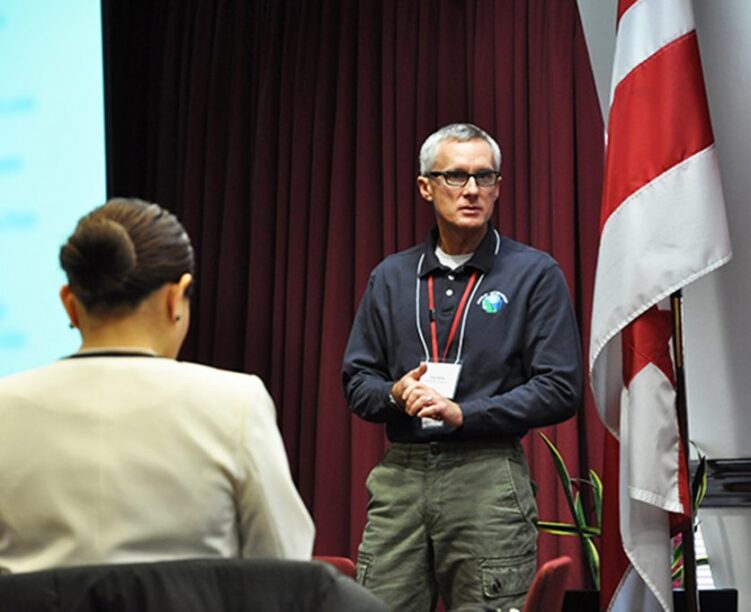
Thomas Noble, Sr. Project Manager, Principal, Horsley Witten Group


Lily pond park design wins award from ri-asla

HW News Release


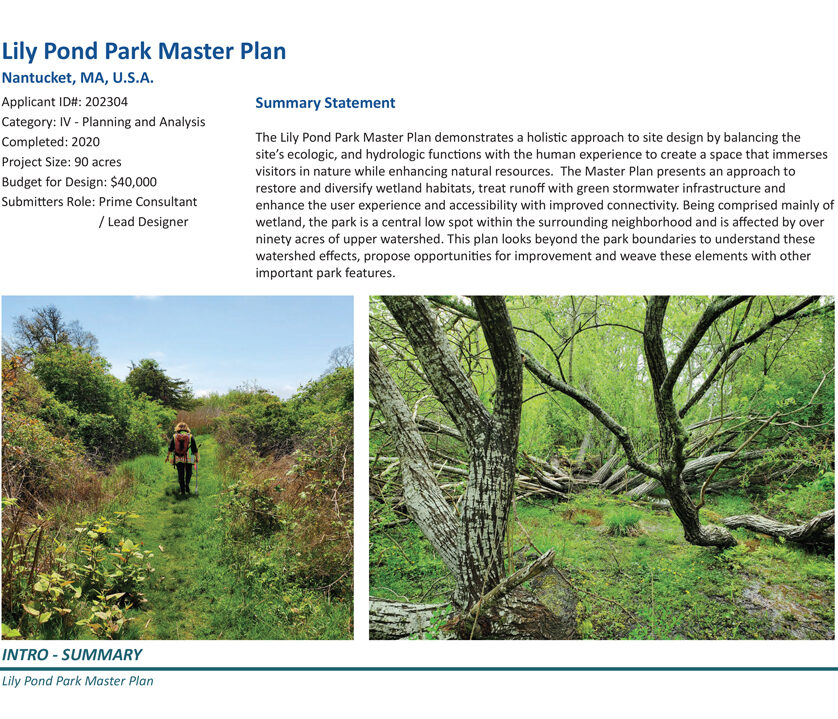
Horsley Witten Group, a full-service environmental consulting firm providing sustainable and resilient design solutions, was honored with a regional American Society of Landscape Architects (ASLA) Merit Award-Planning and Analysis for the Lily Pond Park Master Plan on Nantucket.

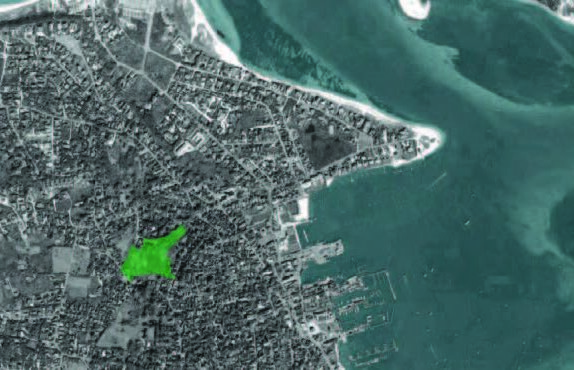
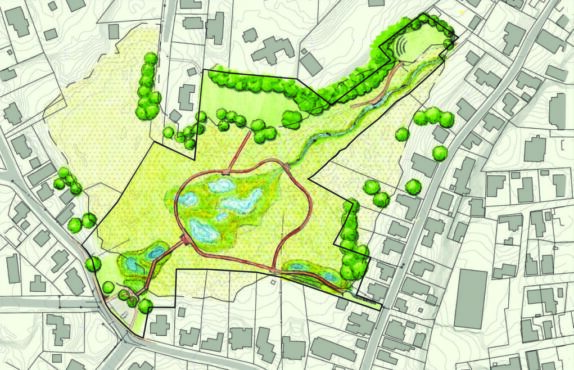
ASLA Rhode Island presented the award to Horsley Witten, recognizing its vision for restoring the ecological and recreational function of the park, a 6.5‐acre property located within the residential outskirts of historic downtown Nantucket and owned by the Nantucket Land Bank.

Though the park itself encompasses only 6.5 acres, the plan presents a preferred approach to clean runoff from 90 acres of residential land surrounding the site using green stormwater infrastructure. In recent years, both the health of surrounding wetlands and park usage have been negatively impacted not only by unmanaged stormwater runoff, but also clogged drainage infrastructure, and invasive vegetation. The key design elements include a new looped boardwalk system over the restored wetland for improved accessibility, additional seating areas, park entrance enhancements, and restoration of a shallow marsh system. Constructed wetlands will be used to treat stormwater runoff coming into the park.

In granting the Merit Award, ASLA Rhode Island offered the following praise for the Horsley Witten Group, “The Lily Pond Park Master Plan presents a preferred approach to restore and diversify wetland habitats, treat runoff with green stormwater infrastructure, and enhance the user experience with improved connectivity. Blending of the visitor experience with water quality and habitat enhancement and analyzing the site within its overall watershed makes the Lily Pond Park Plan a unique example of how we should be designing all sites within their larger ecological systems.”

The team completed the plan in August 2021. Since plan adoption, The Nantucket Land Bank secured a 2023 Southeast New England Program (SNEP) Stormwater and Natural Infrastructure Grant to help fund the construction and monitoring of proposed improvements. Due to the success of the Lily Pond Master Plan, the Nantucket Land Bank has also partnered with the town on a Stormwater Feasibility Study for Downtown Nantucket, using a similar planning approach. Advanced design development and permitting for the Lily Pond Improvements are expected to get underway in spring 2024.

“We are honored to receive recognition from ASLA Rhode Island for our work with the Nantucket Land Bank for the restoration of Lily Pond Park,” said Nathan Kelly, President, Horsley Witten Group. “Our talented team of landscape architects, engineers, and wetland biologists are proud to be closely aligned with ASLA’s mission to participate in the careful stewardship, wise planning, and artful design of cultural and natural environments.”

“We are grateful to be partnering with the Horsley Witten Group on the Lily Pond Park project,” said Jesse Belle, Executive Director of the Nantucket Land Bank. “Their master plan has provided us with an incredible opportunity to restore the wetland at this beloved public park, creating a space where both people and nature can interact and thrive. The project furthers the Land Bank’s goals of preserving scenic views, protecting ecological resources, and enhancing recreational experiences in nature for people to enjoy.”

VIEW THE DESIGN SUBMITTAL


Richard claytor, Jr., P.E.

Sr. Water Resources Engineer

HOW WOULD YOU BEST DESCRIBE THE HORSLEY WITTEN GROUP (HW) AND THE WORK YOU DO TO SOMEONE OUTSIDE OF THE A|E|C AND ENVIRONMENTAL PROFESSIONS?

HW is a small business planning, engineering and environmental service consulting firm. Much of our work involves ensuring that clean and plentiful water is available for use by humans and nature. We do this through careful short- and long-term planning, assessment of natural resources, and designing solutions to ensure a sustainable future for people and the natural world alike. HW is also engaged in making communities a better place to live, work, and play; our mission is to address both environmental and social challenges with sustainable solutions.

IN YOUR OPINION, WHAT IS ONE THING ABOUT THE HORSLEY WITTEN GROUP THAT IS A DIFFERENTIATOR FROM OTHER FIRMS IN YOUR INDUSTRY?

HW is a mission driven firm, and this informs all aspects of our decision-making process, particularly as related to our staff and wanting them to feel proud to work here.

HOW DO THE HORSLEY WITTEN GROUP COMPANY VALUES IMPACT THE WAY YOU OPERATE ON A DAILY BASIS OR MAKE IMPORTANT DECISIONS?

Similar to answer above, our values drive our day-to-day decision making; from the projects and work we pursue, to the clients we work with, and the outcomes we strive to achieve. We frequently ask how a given project aligns with our values. These values are not static nor were they defined by a small group of HW staff. These values can evolve over time or as conditions change and they are truly our shared values.

BEYOND THE REQUISITE TECHNICAL SKILLS, WHAT SPECIAL ATTRIBUTES DO YOU LOOK FOR WHEN YOU HIRE SOMEONE TO JOIN THE HORSLEY WITTEN GROUP TEAM?

We seek out and attract people who really want to make a difference in protecting our natural resources and enhancing the communities where we live. Our staff are committed to making our world a better place.

WE NEED MORE PROFESSIONALS IN THE CIVIL ENGINEERING AND ENVIRONMENTAL INDUSTRY TO KEEP UP WITH THE PROJECT WORK DEMANDS. WHAT IS THE HORSLEY WITTEN GROUP DOING TO ATTRACT THE YOUNGER GENERATIONS INTO THE INDUSTRY?

We work in partnership with local high schools and trade schools to expose future professionals to the kind of work we do. Our staff volunteer annually at local high schools to engage STEM students in a few technical areas covered by our engineering and planning practices, for example. In the last several years, we’ve been very active in the X-CEL Education program working with students in Greater Boston’s underserved communities to expose students to sustainable career paths in the technical and geographic areas where we do business.

WHAT ENCOURAGED YOU TO BECOME AN ENGINEER, AND WHAT ABOUT YOUR CAREER ARE YOU MOST PROUD OF?

I was an analytical-type child, and I enjoyed the order and precision of engineering and I loved nature. Civil engineering afforded me a career that combined the natural and built environment and I gravitated to the earth-sciences (water, soils, geology, etc.). I’m most proud of the people who work for HW and their collective aspirations for the future.

WHAT’S THE BEST PIECE OF LEADERSHIP ADVICE YOU WISH SOMEONE HAD SHARED WITH YOU SOONER?

I had a mentor who often repeated the adage “the client is always right,” and that’s true, except when it’s not. But what was never said, was you can choose your clients and you can both be right. It took me several years to recognize that when we work together with shared values so much more can be accomplished.

LOOKING FORWARD, WHAT ASPECTS OR TRENDS OF THE ENVIRONMENTAL INDUSTRY ARE THE MOST EXCITING FOR YOU?

That is a difficult question. Certainly, the technological advancements in data collection, management and manipulation allow us to do so much more, with more accuracy and in less time. That’s exciting. But equally exciting are the challenges brought on by climate change. Though troubling, they are also motivating, and it often involves water, maintaining or restoring  quality water supplies for the future, managing the risks of changed precipitation characteristics that cause or contribute to flooding and/or drought, reacting to sea level rise and associated coastal impacts,  all while protecting or enhancing nature and human interactions are  important now and will only be more so in the future.


NARRAGANSETT BAY COMMISSION
Macomber Stadium

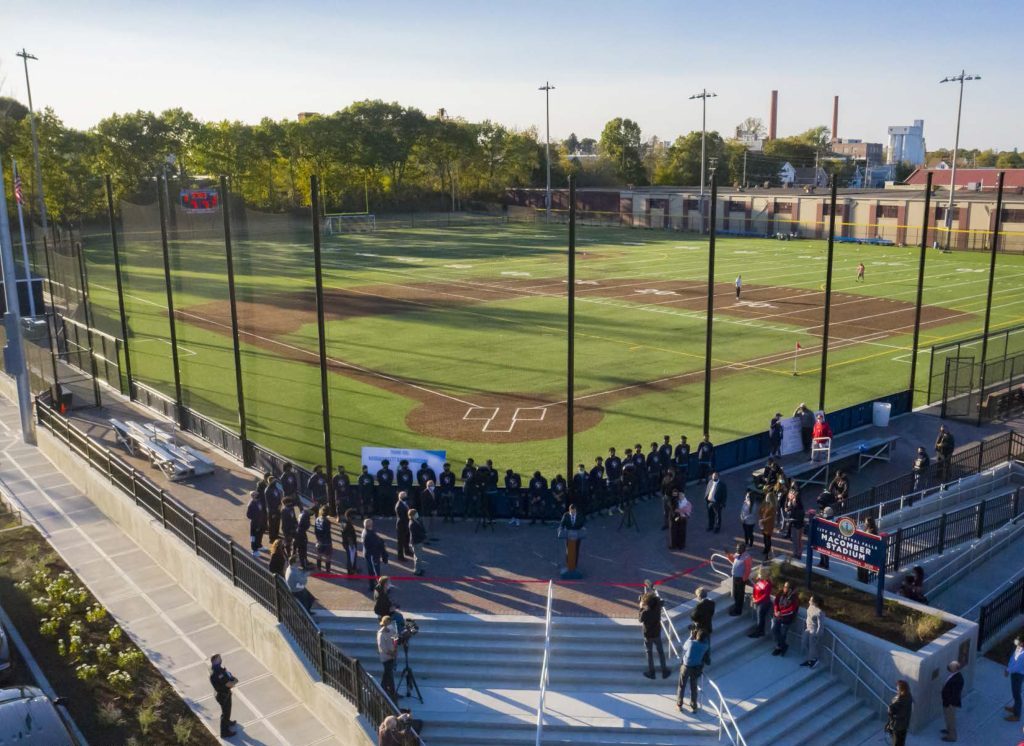
The Narragansett Bay Commission is implementing final phases to reduce Combined Sewer Overflows (CSO) in Pawtucket and Central Falls. One part of this large endeavor is the award-winning green stormwater infrastructure (GSI) project at the Macomber Stadium located in Central Falls.


A combined sewer system (CSS) collects rainwater runoff, domestic sewage, and industrial wastewater into one pipe. Under normal conditions, it transports all the wastewater it collects to a sewage treatment plant for treatment, then discharges to a water body.” 

– U.S. EPA


In 2020 and 2021 this project received awards from two vastly different organizations. First, a “Stormy Award” from the New England Stormwater Collaborative recognized the project as the “Best Stormwater Idea” at the annual New England Stormy Awards. Second, more recently,  the American Sports Builder’s Association named Macomber Stadium “Outstanding Single Field Facility of the Year,” which is a national award. Awards aside, we are proud to have worked with NBC and collaborated on this GSI project with Pare Corp., and Stantec.

The new state-of-the-art synthetic turf athletic field includes a subsurface infiltration system and sand filter with enough capacity to treat and infiltrate a 25-year design storm. The system captures runoff from over six acres of surrounding impervious surfaces. Other GSI features include a permeable paver mezzanine and stormwater bio swales. New landscaping also provides streetscape appearance and overall curb appeal.  The project also restored a contaminated site to its highest potential. Over 10,000 tons of contaminated soils were removed while other soils were encapsulated under an engineered cap that doubles as the final site surface.


Learn More:

Video by Rhode Island Infrastructure Bank
RIIB Project Funding = New Community Sport Fields!!

New England Stormwater Collaborative

American Sports Builder’s Association


Design Team Wins International Competition

Crook Point Bridge, Providence, RI
 

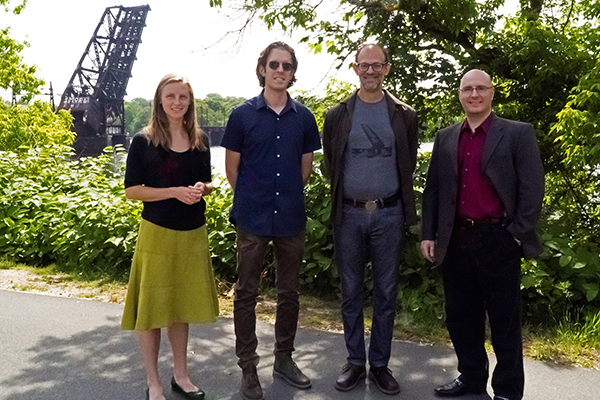
In 2021 the City of Providence received 80 proposals from around the world to design the reuse of the Crook Point Bridge. Of the 80, five teams were asked to submit more details. HW designers Jon Ford, P.E., and Ellen Biegert, RLA joined forces with Jonathan Harris, Urban Designer and Professor at Johnson and Wales University to create concept designs. These designs were shared with the public for comment in early April. In June, the city announced the winning team — Jon Ford, P.E., Ellen Biegert, RLA and Jonathan Harris!

*The winning design boards can be viewed here.


Recently we submitted questions to the design team. Enjoy a few questions below as we promote this important project and share some design inspiration!
 

Do you have a personal connection to the Bridge?

ELLEN – I bike, walk, or run past the bridge several times a week. I’m amazed at the changes in colors and feel that can happen from day to day on the rusted structure and the surrounding river. Even though it has had its fair share of abuse, the Seekonk River offers such a beautiful calm setting that it’s possible to forget you are in a city.

JON – Well I haven’t climbed it (yet), but for the last 15 years I have been part of a group of neighbors advocating for improvements to this stretch of the Seekonk River shoreline just north of the Crook Point Bridge. Access to the water is a huge resource to the people of Providence, and like many post-industrial cities, much of our coastline is hard to access and has crumbling infrastructure. We started advocating for green infrastructure and a watershed plan in 2007 and put a plan together for pedestrian/bike and shoreline resiliency improvements in 2016. We’ve been helping search for implementation funding since.


Did the design incorporate any elements of Rhode Island history/culture? If so, how?

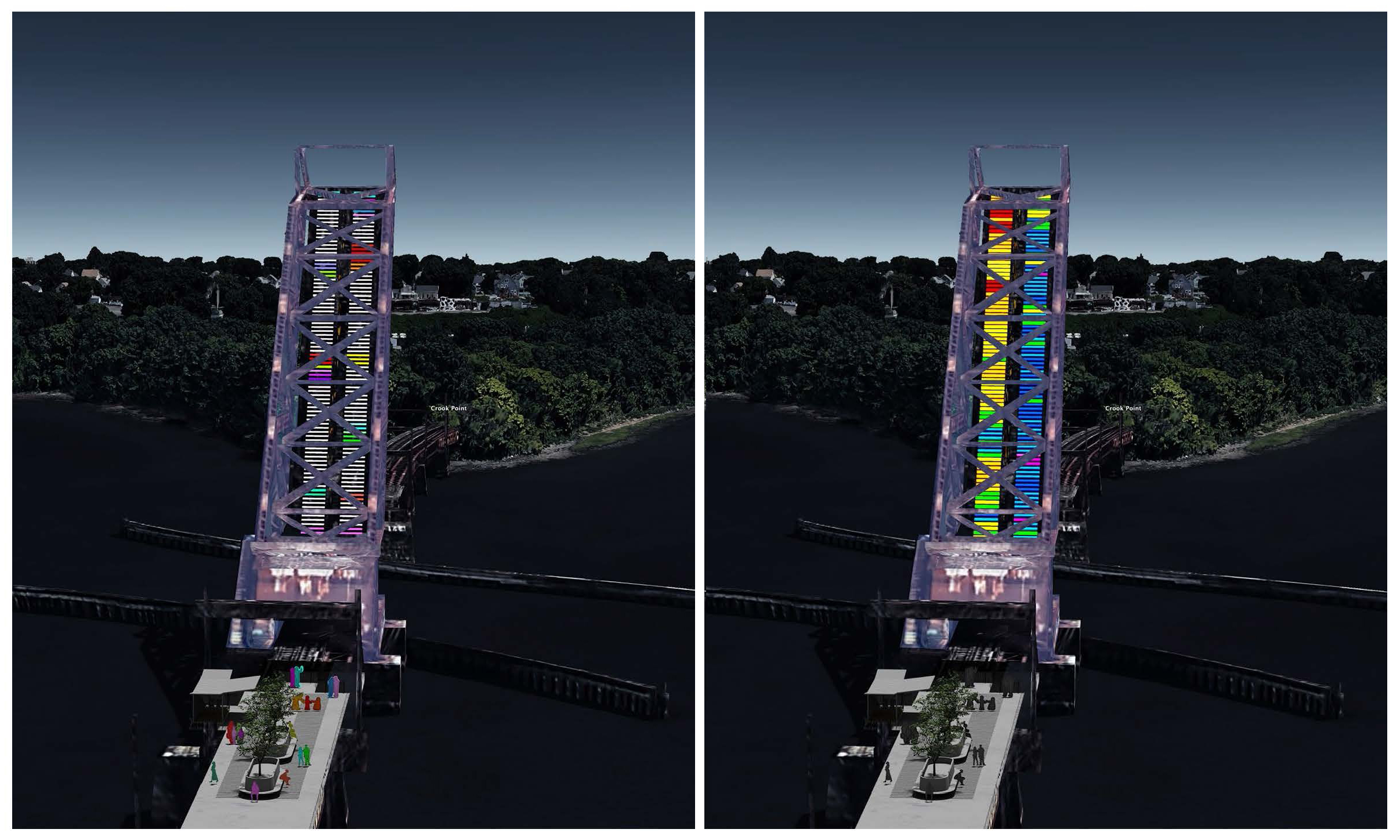
ELLEN – There were elements discussed during the design phase that would help tie the structure and site into the history of the corridor as railroad tracks. This included train station seating and use of the railroad ties throughout the site. However, the structure itself and its location on the Seekonk River is the best connection to the past and depiction of change over time. We wanted to maintain the rusted look during the day to keep the ‘in ruins’ appearance against the river background to remain as a reminder of the changes we’ve made to the land. Incorporating the interactive/programmable lighting at night, connects us to the present with the opportunity to depict culturally relevant topics.

JON – On a personal note, the bridge is a strong symbol of Providence – history and culture. Physical elements of a neighborhood or city like this bridge provide people a connection to where they live that is hard to put your finger on but important in terms of their sense of belonging and pride. This bridge is like that for Providence, to the extent that it’s on t-shirts and it’s on postcards. Often when we work on neighborhood planning and urban design projects, we’re seeking to recreate these postcard moments, so when we already have them, we should celebrate them!


Love the idea of the lights illuminating the structure at night, did something inspire this concept?

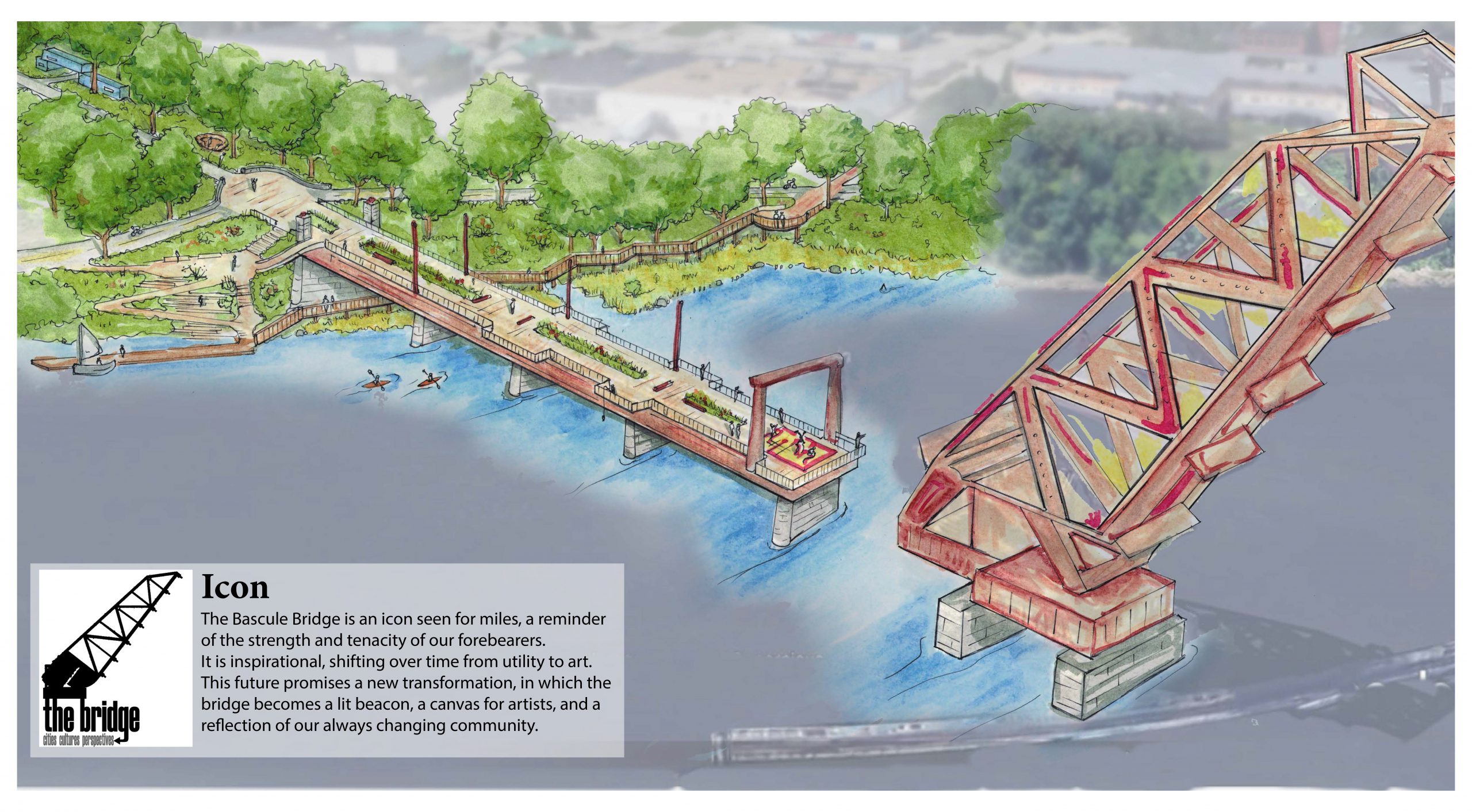
JON – Living in the area we have a sense of how the bridge is a visual touch point – even without lights. You can see glimpses of it from so many locations on both sides of the river, in Providence and East Providence. You can see it from the highway and the Henderson Bridge. As part of our research, we did a photo study showing various perspectives and it was remarkable how visible it is. So, we thought that celebrating the bridge had to include creative and flexible lighting.


If the bridge structure is a beacon, what does it say?

JON – We thought it was critical, and honestly – obvious, that the bridge lighting design should be flexible and allow for various voices and perspectives to be expressed. We had some ideas – including interaction with the lighting system from the piers and the ability for the bridge to reflect nature such as tides or sea level rise. But it was most important to us to provide a canvas that could adapt. As a result, that will help show that the shoreline and this special place will be welcoming to all. We illustrated a few examples on the submittal, as there are so many possibilities!


The interactive LED’s that show motion below the bridge sound like a great idea. Are there any examples of existing structures with similar real-time sensors to give people an idea of what this may look like?

JON – I have always been inspired by the work of Herbert Dreisetl, a German landscape architect. His designs elevate to the level of art, and one I remember him presenting at a conference was a reflecting pool for a small German town square. The design uses microphones in the square that trigger vibrations in the pool based on ambient sound levels, and lighting is designed to project the ripples in the pool onto the buildings that enclose the square. So, the background lighting is more animated during the day, or when there are events, etc. – and calm when the square is calm. Also, visitors can interact with the space in a unique way. This bridge is obviously a bit different, but for me, the idea of finding different ways to project activity in a public space is linked to that.


What part of the proposed design are you most excited about?

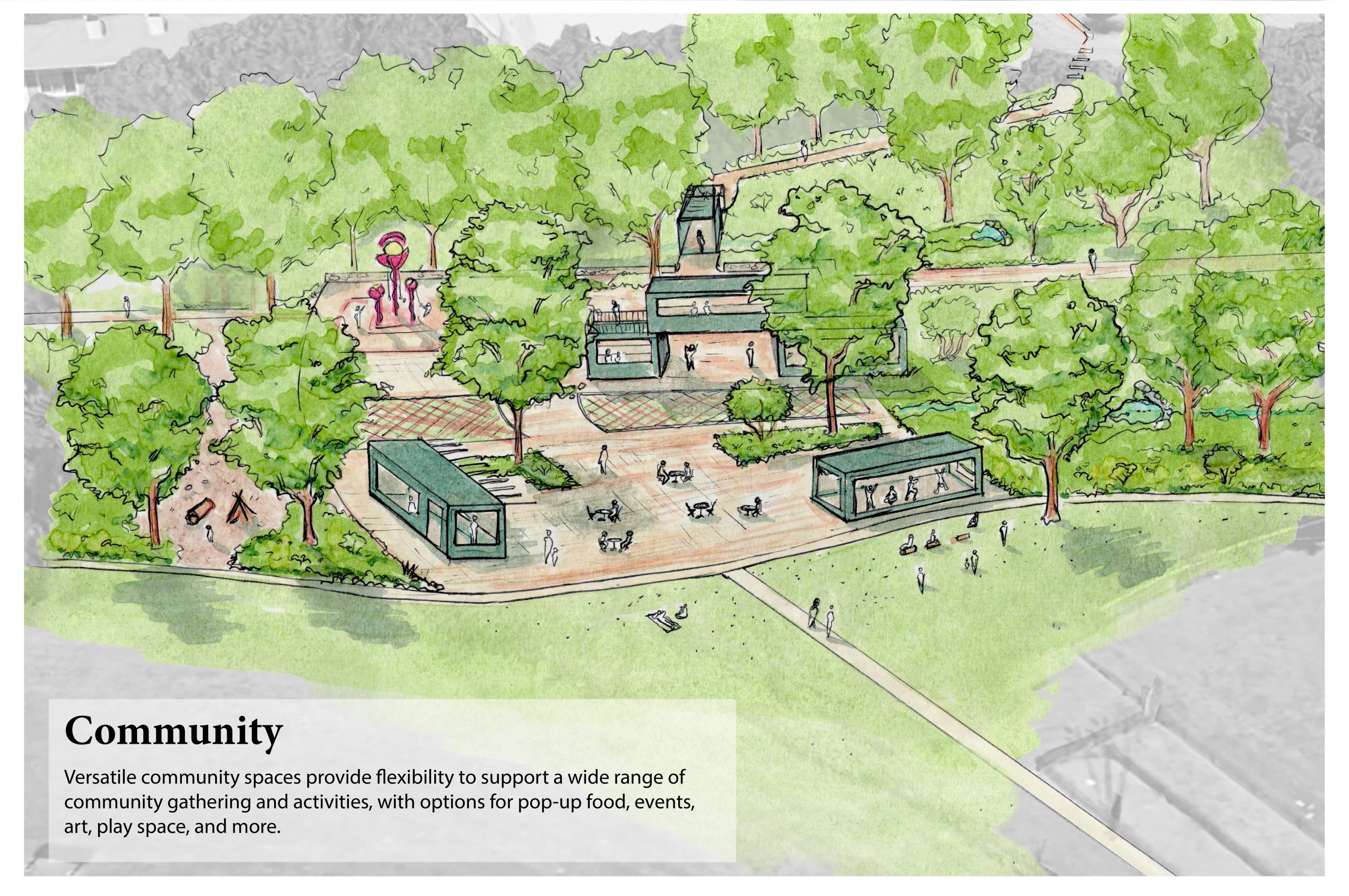
ELLEN – This is a hard question as I am excited about many parts of this design.  If I had to pick, I would  say the community element.  Community engagement and interaction are components we tried to weave throughout the entire design. Having spaces that encourage neighbors to engage through lights or other interactive art elements, can encourage community building and promote play for everyone – something we could all use. Also, this past year has proven how important it is to have flexible outdoor space for community gathering, mental health and is vital for a healthy city.

JON – That’s a good question. Once the project is built, I think what will be most exciting for me is to see people of various backgrounds, ages, life experiences, enjoying the shoreline in ways they never have been able to. If this is built as envisioned, it will mean a lot of different things to different people, and I look forward to seeing that result! I also can’t wait to bring my kids there and see them running up the pier to see the bridge up close. That will be truly amazing!


I see fishing and kayaking mentioned. Can you discuss the challenges of creating waterfront access for multiple uses and how this design addresses those challenges in creative ways?

ELLEN – Finding space for people to interact with the river while balancing restoration and multiple uses was approached by layering the benefits of each component. The accessible ramp that provides access for kayak users doubles as the path for seating, so the dock at the bottom could be utilized as a stage for small gatherings. The pier includes areas off the center walkway with space for someone to set up a fishing line and stay for a while without feeling like they are being crowded out. These little niches would include areas for fishing equipment and poles but when not in use, would appear to be an overlook and blend into the rest of the usable space.
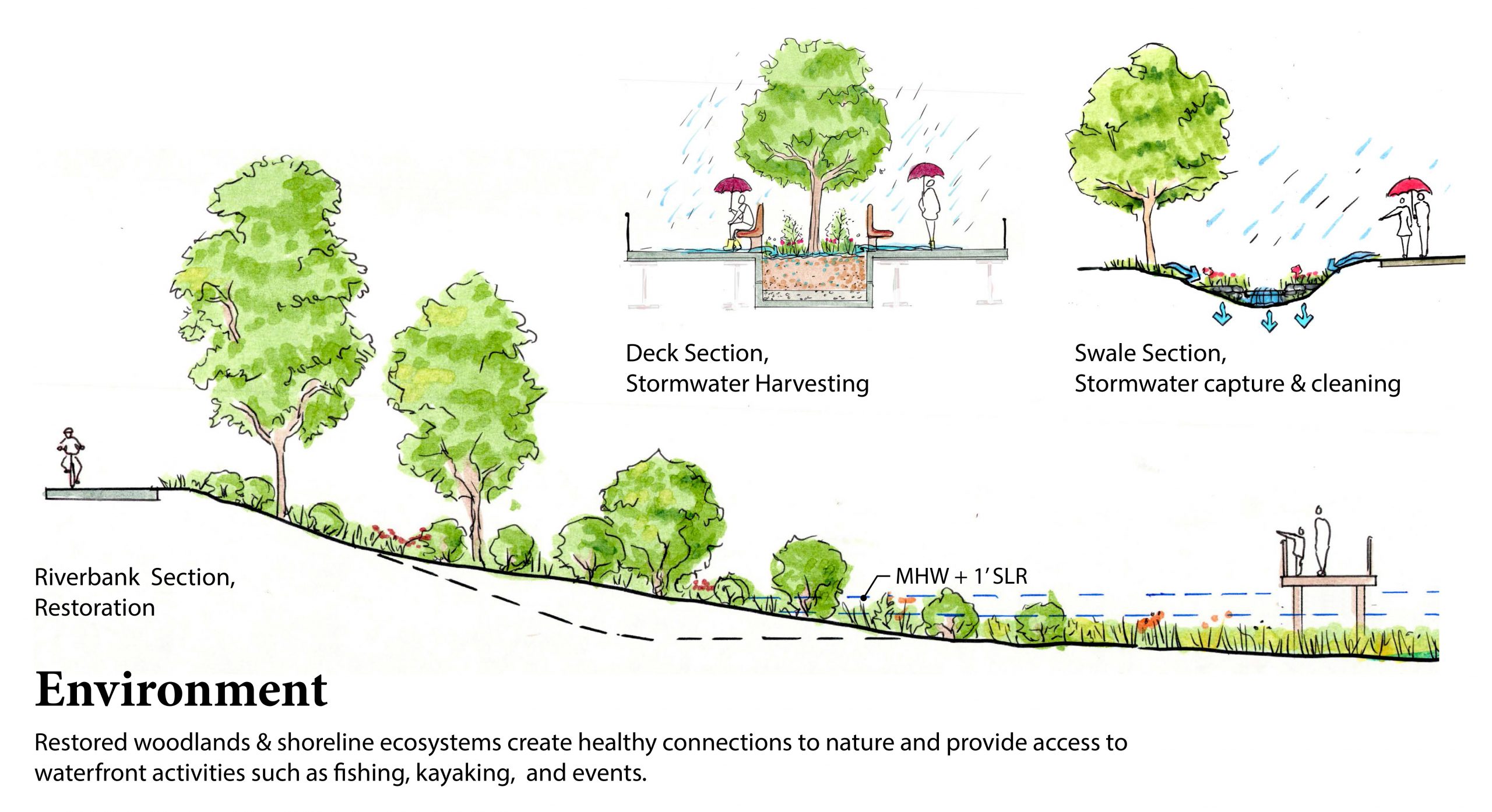


The design is super cool. I especially like the shout-out to bouldering as a potential use near the tunnel. Providence has one of the best bouldering sites in the area (Lincoln Woods) and there are at least 3 climbing gyms in the area, so this is a great opportunity to share the sport with folks who might not be able to access those other places to climb.  Are they proposing real boulders, or some artificial set-up?

ELLEN – Thanks! The back tunnel area has a lot of potential to become a unique feature and incorporating a use that people seek out is important for activating the space. Bouldering and climbing could fit this space well and having more locations in the city may help the community grow. As far as the specific material, there aren’t existing natural features, and the specifics for layout and material would be developed with the local community who would be using it, as well as balancing choices with other goals such as maintaining canopy and incorporating art elements.


Do you have any more details to share about the mixed-use housing (i.e., funding source, NGO; timeline, etc.)?

JON – We proposed the mixed-use housing as an aspirational idea for the City’s consideration. This idea will require more thought and discussion to become a reality! We included it because we think more activity will help bring more people to the shoreline 24-7, providing much-needed housing, helping to activate the public spaces, creating safety through having more “eyes on the street”, and helping generate tax revenue for the city. It will also make the public spaces livelier if they have commercial space woven in – like cafes, restaurants, and maybe even small-scale shops.
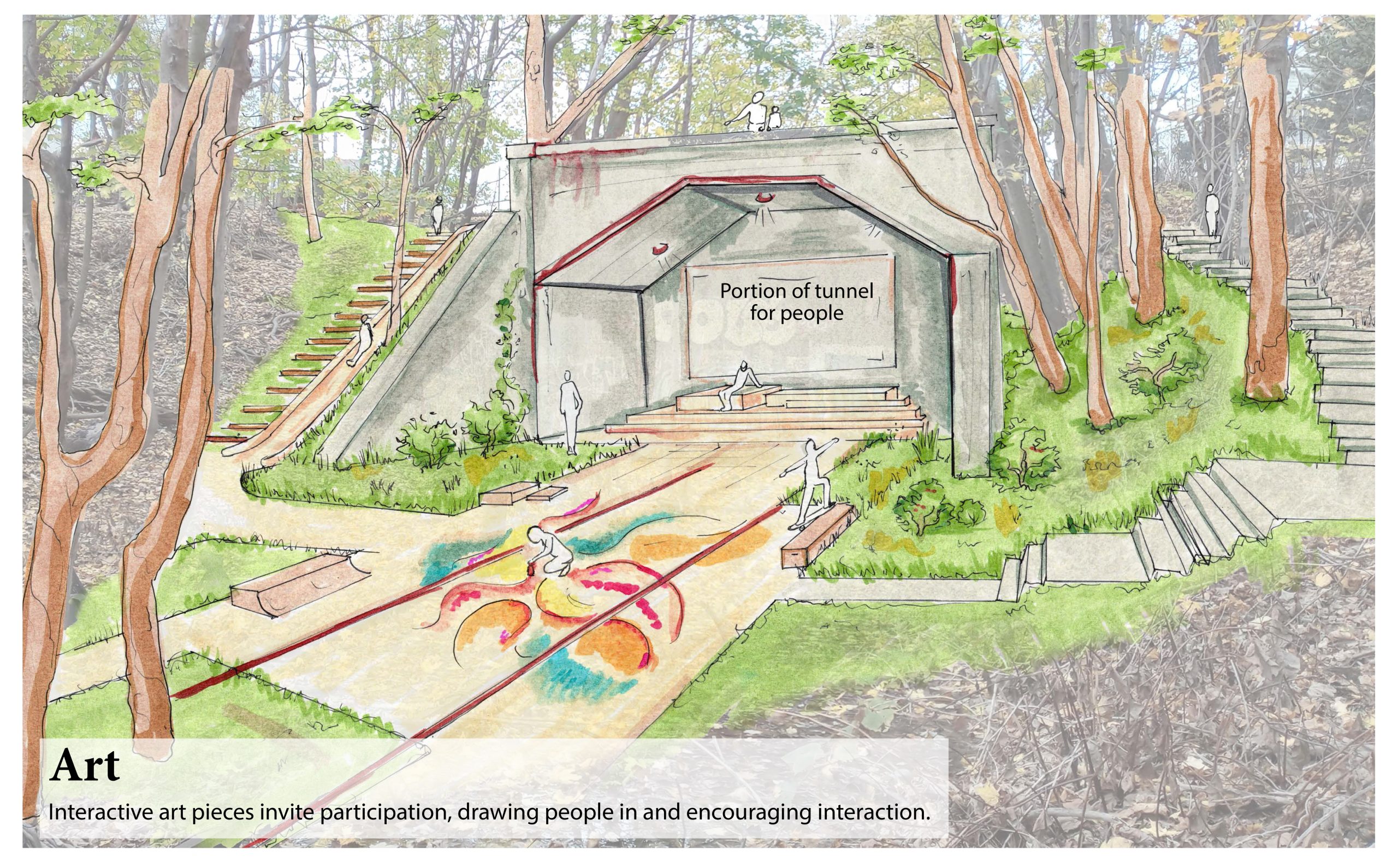


Who will be designing the art pieces that get installed? Will they be local?

JON – We think it should be a requirement that art pieces should be designed locally. There is great precedent for that with public art in the City via , Arts, Culture, and Tourism, the Avenue Project  and much more. That will be another element that defines the space that remains authentically Providence and welcoming to all. The process is to be determined, but it could also be evolving where pieces rotate in and out over time.


Ellen Biegert, Jon Ford, Jonathan Harris, Jason Rainone